A safe load indicator will tell you exactly how heavy a load is. What it will not tell you is which direction the force is pulling from — and that omission is where a surprising number of crane accidents begin.
A load can sit comfortably within the rated capacity and still tear a crane apart, if the rope is dragging it sideways. A mobile crane can be lifting well inside its load chart and still tip, if its base is a degree or two out of level. In both cases, weight was never the problem. Angle was.
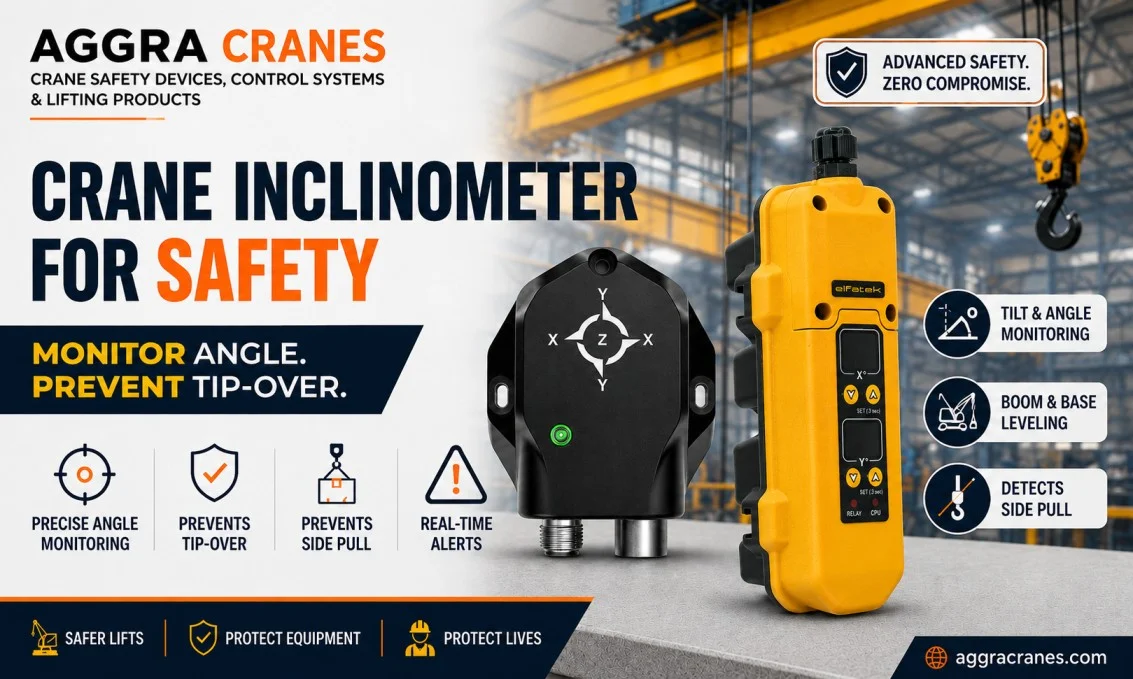
This is the blind spot a crane inclinometer for safety exists to close. By measuring tilt and angle — of the boom, the base, the structure, or the hoist rope itself — it gives the crane’s safety system the missing dimension: not just how much force, but in what direction. This article explains what inclinometers measure, how angle causes tipping and structural damage, why side pull is so destructive, and how angle monitoring makes Indian lifting operations meaningfully safer.
What Is a Crane Inclinometer?
An inclinometer — also called a tilt sensor or crane angle sensor — measures the angle of an object relative to gravity, or to a defined reference plane. Modern industrial inclinometers are typically MEMS-based devices that sense the direction of gravitational acceleration and convert it into a precise angle reading in degrees. Single-axis units measure tilt in one plane; dual-axis units measure it in two, giving a complete picture of how a surface is oriented.
The device continuously outputs its angle reading to the crane’s controller, where it can drive a display, trigger a warning, or enforce a cut-out. Robust industrial versions are sealed against dust and moisture, hardened against vibration and shock, and specified for the wide temperature swings of Indian plants — because a sensor that fails in a foundry or on an outdoor gantry protects nothing.
What makes an inclinometer valuable is that angle is genuinely invisible to other sensors. A load cell measures force but knows nothing about direction. A limit switch knows position but not orientation. Only an inclinometer answers the question which way is this pointing, and is that safe?
Where Angle Monitoring Matters on a Crane
Inclinometers do several distinct jobs on a crane, and it is worth separating them because they address different risks.
Boom angle on variable-radius cranes
On mobile, tower and crawler cranes, an inclinometer measures the boom angle. Combined with boom length, this gives the working radius — the horizontal distance from the crane’s centre of rotation to the load. That radius is what determines the crane’s permitted capacity from its load chart.
This is why the inclinometer is an essential input to a load moment indicator. Weight alone cannot tell an LMI whether a lift is safe; it must know the geometry, and the boom angle sensor is what supplies it. Get the angle reading wrong and the LMI calculates against the wrong line of the load chart — which means it permits a lift the crane cannot actually take.
Base and chassis level
For a mobile crane on outriggers, being level is not cosmetic — it is structural. A crane’s load chart assumes the machine is level. When the base is tilted, the boom leans, the load swings out beyond its assumed radius, and the overturning moment increases while the crane’s resisting moment falls.
The effect is disproportionate: even a small out-of-level condition, of a degree or two, can meaningfully reduce a crane’s safe capacity, and the loss grows with boom length and radius because the lean is amplified along the length of the boom. A dual-axis inclinometer on the chassis continuously monitors level in both planes and warns the operator before a lift is attempted on an unsafe setup — one of the most direct tipping-prevention functions there is.
Structure and gantry tilt
On gantry cranes and large structures, inclinometers monitor tilt and skew — the condition where one end of a bridge or gantry leads the other. Skew stresses wheels, rails and structure, causes binding and premature wear, and in severe cases risks derailment. Continuous tilt monitoring catches it early.
Rope angle and side pull
This is the application that matters most in the overhead and gantry cranes that fill Indian plants — and it deserves its own section.
The Side Pull Problem: When the Rope Isn’t Vertical
A crane hoist is designed to lift straight up. The hoist rope should hang vertically over the load, so that the force it carries runs cleanly down the load path the crane was engineered for.
Side pull — also called side loading or dragging — happens when the load is not directly beneath the hook and the rope is pulled off vertical. It occurs when an operator drags a load sideways across the floor instead of positioning the trolley over it, when a snagged load is yanked free, or when the crane is used to pull something horizontally.
It is common, it often looks harmless, and it is genuinely destructive.
Why side pull is so damaging
The crane’s structure, ropes and mechanisms are designed for vertical force. Angle the rope, and you introduce a lateral component of force that nothing was designed to take.
The wire rope suffers first: pulled at an angle, it can jump out of sheave grooves, chafe against flanges, and spool unevenly onto the drum, crushing and deforming the layers beneath. Rope damage of this kind shortens rope life dramatically and, at worst, precedes rope failure.
The structure suffers too. Lateral force twists the bridge and trolley, applies bending and torsion the girders were not designed for, and drives wheels hard against rails — accelerating fatigue, wear and misalignment across the crane.
And the load becomes unpredictable. A load dragged sideways swings violently when it breaks free, and that uncontrolled swing endangers everyone nearby and can strike structures or equipment.
Here is the crucial point: none of this shows up on a load cell. A side pull can occur with a load well inside the rated capacity — the SLI reads a comfortable figure and stays silent, while the crane is being damaged. Weight-based protection is blind to this failure mode entirely.
How angle monitoring stops it
A rope angle sensor or inclinometer detects deviation of the hoist rope from vertical. As the angle grows past a set threshold, the system warns the operator; if it grows further, it can inhibit the motion that is causing the pull. The operator is prompted to do the correct thing: position the trolley directly over the load and lift vertically.
The result is that a damaging habit is caught in the moment, rather than discovered months later as a worn rope, a cracked weld or a derailed wheel.
How Inclinometers Prevent Tipping
Tipping is a contest between two moments. The overturning moment — the load multiplied by its radius — tries to rotate the crane about its tipping axis. The crane’s resisting moment, from its own weight and its outrigger or track base, opposes it. When the overturning moment wins, the crane goes over.
Angle governs both sides of that contest, which is why inclinometers are central to tipping prevention:
- Boom angle determines the radius, and radius directly multiplies the overturning moment. A boom lowered to a longer radius increases leverage on the crane dramatically.
- Base level determines the resisting moment. An out-of-level base shifts the crane’s centre of gravity toward the tipping axis and pushes the load further out than the load chart assumes — attacking both sides of the equation at once.
- Side loading of the boom introduces lateral force that the boom, engineered for axial loading, resists poorly.
An inclinometer feeding a load moment indicator ensures the system is always calculating against the crane’s true geometry. An inclinometer on the chassis ensures the crane is only lifting from a properly level setup. Together, they close the gap between what the crane thinks it is doing and what it is actually doing — which is precisely where tipping accidents live.
What an Inclinometer Adds to a Crane Safety System
Seen alongside the other devices on a crane, the inclinometer’s role becomes clear.
| Device | What it senses | What it cannot see |
| Load cell / SLI | How heavy the load is | The direction the force is pulling from |
| Limit switch | That a position has been reached | Orientation or tilt |
| Inclinometer | Angle and tilt — boom, base, structure, rope | Load weight |
| LMI | Load and geometry together | — it combines both, using an inclinometer as an input |
The takeaway is that these devices are complements, not alternatives. An SLI without angle monitoring is blind to side pull. An LMI cannot function without an inclinometer supplying boom angle. Tilt monitoring crane systems fill a gap that weight-based protection structurally cannot.
Specifying an Inclinometer Safety Device
A few practical factors determine whether an inclinometer safety device performs in an Indian plant:
- Accuracy and resolution. Because small angles matter — particularly for base level — the sensor must resolve fractions of a degree reliably.
- Single or dual axis. Base levelling needs two axes; boom angle typically needs one.
- Vibration and shock filtering. A crane is a moving, vibrating machine; the sensor must reject noise without becoming slow to respond to genuine change.
- Environmental protection. Sealed housings with an appropriate IP rating, and a temperature range that covers a foundry’s heat or an outdoor gantry’s seasonal extremes.
- Output and integration. The signal must integrate cleanly with the crane’s controller, LMI or PLC, and ideally with data logging and remote monitoring.
- Threshold configuration. Warning and cut-out angles must be set correctly for the crane and verified — an angle threshold that is programmed but never tested is an assumption, not a safeguard.
- Like any sensor, an inclinometer must be verified periodically to ensure its zero and its readings have not drifted.
Angle and Side Pull Protection from Aggra Cranes
At Aggra Cranes & Engineering LLP, angle monitoring is part of the safety instrumentation we supply, install, integrate and calibrate for Indian lifting operations. We help plants add the sensing that weight-based protection cannot provide — inclinometers and angle sensors for boom angle and base level, tilt and skew monitoring on gantry structures, and rope angle sensing to detect and prevent damaging side pull.
Working with established technology partners including Kymati, Elfatek, GIS and Danfoss, we integrate these devices with the wider safety and control ecosystem — safe load indicators and load moment indicators, load cells, limit switches, anti-collision systems and control systems — so that angle protection works as part of a coherent whole rather than an isolated add-on. And because a sensor is only as good as its calibration and its configured thresholds, we support the verification that keeps it trustworthy over the crane’s life.
Conclusion
Weight is only half the story of a safe lift. The other half is angle — the geometry that decides whether a load within capacity is placed safely or forces the crane into a condition it was never designed to survive. A crane inclinometer for safety supplies that missing half: it tells a load moment indicator the true radius, it stops a mobile crane lifting from an out-of-level base, it catches gantry skew before it wears out a rail, and it detects the side pull that a load cell will never see.
Fit angle monitoring, set the thresholds correctly, verify them, and keep them calibrated — and the crane’s safety system finally knows not just how hard it is being pulled, but from which direction. That is the difference between a lift that is within capacity and a lift that is genuinely safe.
To add angle, tilt and side pull protection to your cranes, talk to the team at Aggra Cranes.
Frequently Asked Questions
-
What is a crane inclinometer and what does it do?
A crane inclinometer, also called a tilt sensor or crane angle sensor, measures the angle of a component relative to gravity and reports it continuously to the crane’s control system. On a crane it performs several distinct jobs: measuring boom angle on variable-radius cranes (an essential input to a load moment indicator), monitoring whether a mobile crane’s base is level, detecting tilt or skew in gantry structures, and sensing when the hoist rope has been pulled off vertical. Its purpose is to give the safety system information about direction and orientation, which weight-measuring devices cannot provide.
-
How does an inclinometer help prevent a crane from tipping?
Tipping happens when the overturning moment — load multiplied by radius — exceeds the crane’s resisting moment. Angle governs both. Boom angle determines the working radius, so an inclinometer feeding a load moment indicator ensures the system calculates against the crane’s true geometry rather than an assumed one. Separately, a dual-axis inclinometer on the chassis confirms the crane is level before lifting: an out-of-level base shifts the centre of gravity toward the tipping axis and pushes the load beyond its assumed radius, reducing safe capacity significantly. By monitoring both, inclinometers close the gap between what the crane assumes and what is actually true.
-
What is side pull, and why is it dangerous?
Side pull, or side loading, occurs when the hoist rope is not vertical — typically when a load is dragged sideways instead of the trolley being positioned directly above it. It is dangerous because a crane is engineered for vertical force. Angling the rope introduces lateral force that can pull the rope out of sheave grooves, cause uneven and damaging spooling on the drum, twist the bridge and trolley, stress girders in bending and torsion, drive wheels hard against rails, and cause violent load swing when the load breaks free. Critically, side pull can occur with a load well within the rated capacity, so a load cell or SLI will not detect it at all.
-
Can a safe load indicator detect side pull?
No — and this is the key gap that angle monitoring fills. An SLI measures the weight of the load and compares it against rated capacity. It has no way of knowing the direction from which the force is applied. A load being dragged sideways may register a perfectly acceptable weight while the crane is being structurally damaged. Only a rope angle sensor or inclinometer, which detects deviation from vertical, can identify side pull and warn the operator or inhibit the offending motion.
-
What should I look for when specifying a crane inclinometer?
Look for accuracy and resolution fine enough to detect the small angles that matter, particularly for base levelling; the correct number of axes (dual-axis for levelling, single-axis typically for boom angle); effective vibration and shock filtering, since a crane is a constantly moving machine; sealed construction with an appropriate IP rating and a temperature range suited to your environment, whether that is a foundry’s heat or an outdoor gantry’s extremes; and clean integration with the crane’s controller, LMI or PLC. Finally, ensure warning and cut-out thresholds are correctly configured, actually tested, and that the device is periodically recalibrated so its readings stay trustworthy.