Reliable material handling depends on lifting equipment that performs consistently, day after day, under the actual demands of the workplace. Whether the job is routine machine maintenance, a busy production line, a workshop bay or a more specialised industrial process, an electric chain hoist has to deliver safe, predictable lifting while meeting the site’s operational and safety requirements.
GIS AG of Switzerland has been engineering electric chain hoists and complete lifting solutions for more than sixty years. Its range spans standard industrial hoists as well as variants built for specific environments, safety needs and control requirements.
Aggra Cranes works with customers to match the right GIS lifting solution to their actual application, load profile and operating conditions.
What Actually Makes a Chain Hoist “Suitable”?
Lifting capacity alone doesn’t tell you whether a hoist is right for the job. The correct choice comes down to a combination of factors working together:
- Safe, dependable lifting performance
- Capacity matched to the real working load
- Lifting speed suited to the task
- Adequate lifting height
- Consistent, reliable braking
- Effective overload protection
- A duty rating that matches usage
- A compact footprint where space is tight
- Straightforward operation and maintenance
- Compatibility with the travelling arrangement
- Fitness for the operating environment
GIS builds its electric chain hoists in a range of configurations precisely so these requirements can be addressed across very different applications.
GIS GP Series: Built for Everyday Industrial Lifting
The GP series is GIS’s core industrial hoist line, engineered for reliability, a compact build and flexible installation. Depending on configuration, it can be supplied at different lifting capacities and paired with manual or motorised trolleys.
Common uses include:
- Industrial production
- Machine maintenance
- Material handling
- Workshops
- Assembly lines
- Automotive manufacturing environments
- Process industries
- Crane systems
- Maintenance operations
- General industrial lifting
For customers who need a dependable, everyday industrial hoist, the GP series is worth evaluating against the required capacity, lifting height, duty cycle and site conditions.
Overload Protection: Two Different Things People Often Conflate
Overload protection is one of the most important — and most misunderstood — considerations in hoist selection. An overload can happen for several reasons: a miscalculated load, a snagged or caught load, unexpected resistance during the lift, or another unforeseen event on site.
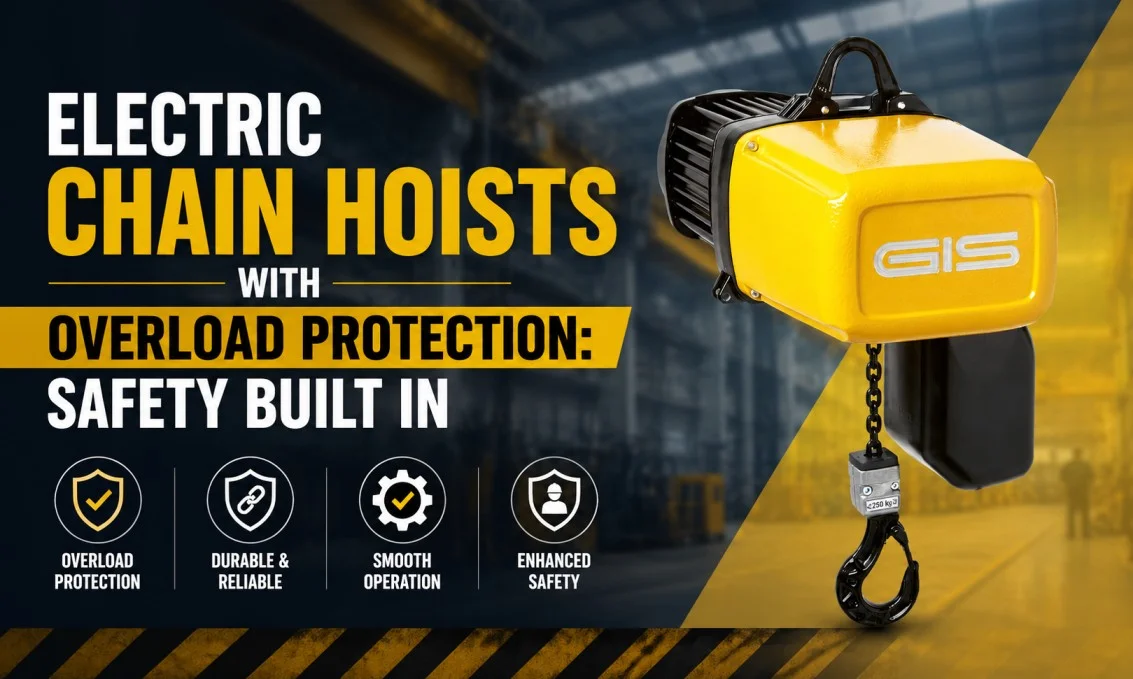
GIS GP series hoists build in an adjustable slipping clutch as their mechanical overload safeguard. It’s worth being clear that this is a different function from electronic load monitoring.
Mechanical Protection: the Slipping Clutch
The slipping clutch guards against excessive lifting torque. Built into the hoist itself, it’s designed to stop the hoist from continuing to lift once the force exceeds the set protection threshold. What it does not do, on its own, is show the operator how much load is actually being lifted.
Electronic Load Monitoring: Seeing the Load, Not Just Limiting It
Some applications call for more than a mechanical cut-off. An electronic load-monitoring system can add:
- Actual load indication
- A digital load display
- Pre-warning alerts
- Overload alarms
- Electronic shutdown
- Ongoing load monitoring
- Integration with a wider control system
As an example: on a hoist rated for 1,000 kg, electronic load monitoring lets the operator see in real time whether the current load sits around 700 kg, 850 kg or closer to the rated limit.
So the real question for any project is whether basic overload protection is enough, or whether overload protection combined with load measurement and monitoring is actually needed. That answer depends on the specific GIS model and configuration involved.
Matching the Hoist to the Environment
Not every industrial site looks the same. A hoist working inside a climate-controlled workshop faces very different conditions from one operating outdoors, in a corrosive atmosphere, in an entertainment rigging application, or in a potentially explosive zone. GIS addresses this with dedicated product variants rather than a one-size-fits-all hoist.
Corrosion-Resistant Environments
Moisture, chemical exposure and aggressive atmospheres call for hoists built to resist corrosion. GIS covers this with specialised solutions, including the GPR series, relevant to sectors such as:
- Chemical processing
- Pharmaceutical facilities
- Food processing
- Outdoor installations
- Other demanding industrial environments
As always, the exact configuration should be chosen based on the actual environmental conditions on site.
ATEX (Explosive Atmosphere) Applications
Where a hoist will operate in a potentially explosive environment, selection has to follow the applicable hazardous-area classification. GIS offers ATEX-rated electric chain hoists for these applications. Before specifying one, the zone classification, gas or dust category and any other project-specific requirements need to be confirmed.
Hoists Rarely Work Alone: Trolleys and Travel Systems
In many installations, the hoist has to travel along a beam or crane structure rather than stay fixed in one spot. GIS electric chain hoists can be paired with:
- Manual trolleys
- Motorised trolleys
- Monorail systems
- Crane systems
- Slewing jib cranes
- Light crane systems
The hoist and trolley should be specified together, factoring in hoist capacity, beam or flange width, travel speed, required travel distance, duty cycle and how the system will be installed. Treating the hoist as an isolated component, separate from how it will actually travel, tends to create problems later.
Light Crane Systems for Workstation-Level Handling
For assembly stations and production areas, GIS also offers light crane systems that move loads efficiently between workstations and reduce manual handling. These fit well in:
- Assembly stations
- Production lines
- Machine loading
- Machine maintenance
- Material transfer
- Workshop operations
- Ergonomic workplace lifting
A GIS electric chain hoist can be built into the wider system to deliver the actual lifting function within it.
Choosing the Right GIS Hoist: Eight Things to Work Through
- Load capacity — Establish the maximum safe working load, not just the occasional peak load. Build in the right safety margin for real operating conditions.
- Lifting height — The required hook travel drives chain length and shapes the rest of the hoist configuration.
- Lifting speed — Repetitive production work often needs speed; positioning-critical tasks often need control and precision instead.
- Duty cycle — Occasional maintenance use and continuous production use place very different demands on a hoist.
- Operating environment — Indoors or outdoors, humid, dusty, chemically aggressive, potentially explosive, or entertainment-rigging — each changes the right specification.
- Control system — Pendant control, radio remote control, contactor control, frequency-controlled operation, synchronous operation, or integration with an existing crane control system.
- Overload protection — Decide whether standard mechanical protection is sufficient, or whether electronic load monitoring is also needed.
- Trolley arrangement — If the hoist needs to travel, the manual or motorised trolley has to match the beam dimensions and travel requirements.
Why Capacity Alone Isn’t a Selection Criterion
Two applications can both call for a 1-tonne hoist and still need very different equipment. One might involve occasional maintenance lifts; the other, continuous production lifting with high cycle counts and precise positioning demands. The right hoist follows from the complete picture of the application — not the rated capacity in isolation.
At Aggra Cranes, our starting point is always the full picture: load, lifting height, speed, duty cycle, environment, control needs, travel arrangement and safety requirements — before we narrow down to a specific hoist.
A Broader Lifting Portfolio, Not Just a Single Hoist
One advantage of working with the GIS range is that the conversation doesn’t have to stop at a single lifting unit. Depending on the application, GIS solutions extend to:
- Electric chain hoists
- Chain motors
- Manual and motorised trolleys
- Light crane systems
- Specialised lifting equipment
- Application-specific configurations
That range makes it possible to put together a more complete material-handling solution around what the customer actually needs, rather than fitting the application around a fixed product.
How Aggra Cranes Helps
Our role at Aggra Cranes is to help customers land on the right lifting equipment for their application — not simply to move a standard product off the shelf. For GIS electric chain hoist projects, we work through:
- Required lifting capacity
- Lifting height
- Lifting speed
- Duty cycle
- Hoist model selection
- Trolley selection
- Control requirements
- Overload protection
- Electronic load monitoring, where needed
- Crane integration
- Environmental requirements
- Any special application requirements
From there, we can point toward the appropriate GIS configuration for the application at hand.
Final Thoughts
Selecting an electric chain hoist is a decision worth getting right the first time. Capacity matters, but so does fit with the operating environment, duty cycle, lifting height, speed, control system and safety requirements. GIS electric chain hoists bring Swiss engineering to a wide span of configurations, covering standard industrial hoists, travelling hoists with trolleys, light crane systems, corrosion-resistant builds, entertainment-industry technology and specialised protection classes.
Whatever the application, the right GIS model comes down to matching it against the actual operating conditions — and that’s where Aggra Cranes can help.
Frequently Asked Questions
Does a GIS electric chain hoist include overload protection?
Yes. GIS industrial hoists such as the GP series include an adjustable slipping clutch as their mechanical overload safeguard.
Does overload protection mean the hoist shows the actual load being lifted?
No. Mechanical overload protection and electronic load monitoring are separate functions. Electronic load monitoring, where fitted, can add actual load indication, pre-warning and other functions depending on the configuration.
Can a GIS electric chain hoist come with a trolley?
Yes. GIS hoists can be paired with manual or motorised trolleys for travelling applications.
Can GIS hoists be used outdoors?
GIS offers configurations suited to outdoor use. The right model still needs to be chosen against the specific environmental conditions and application.
Does GIS offer ATEX-rated hoists?
Yes, for applications requiring explosion protection. The exact configuration must match the applicable hazardous-area requirements.
Can GIS hoists be integrated into crane systems?
Yes — with trolley systems, monorails, light crane systems and other travelling arrangements.
How do I choose the right GIS electric chain hoist?
Work through load capacity, lifting height, lifting speed, duty cycle, operating environment, control arrangement, trolley requirement and safety functions. Aggra Cranes can help evaluate these against your application.
About Aggra Cranes
Aggra Cranes provides lifting and material-handling solutions for industrial customers, including electric chain hoists, crane systems, load monitoring, overload protection and related equipment. We work with customers to understand their application and recommend equipment based on capacity, duty, environment, safety and operational needs.
For GIS electric chain hoist requirements, get in touch with the Aggra Cranes team for technical and commercial support.