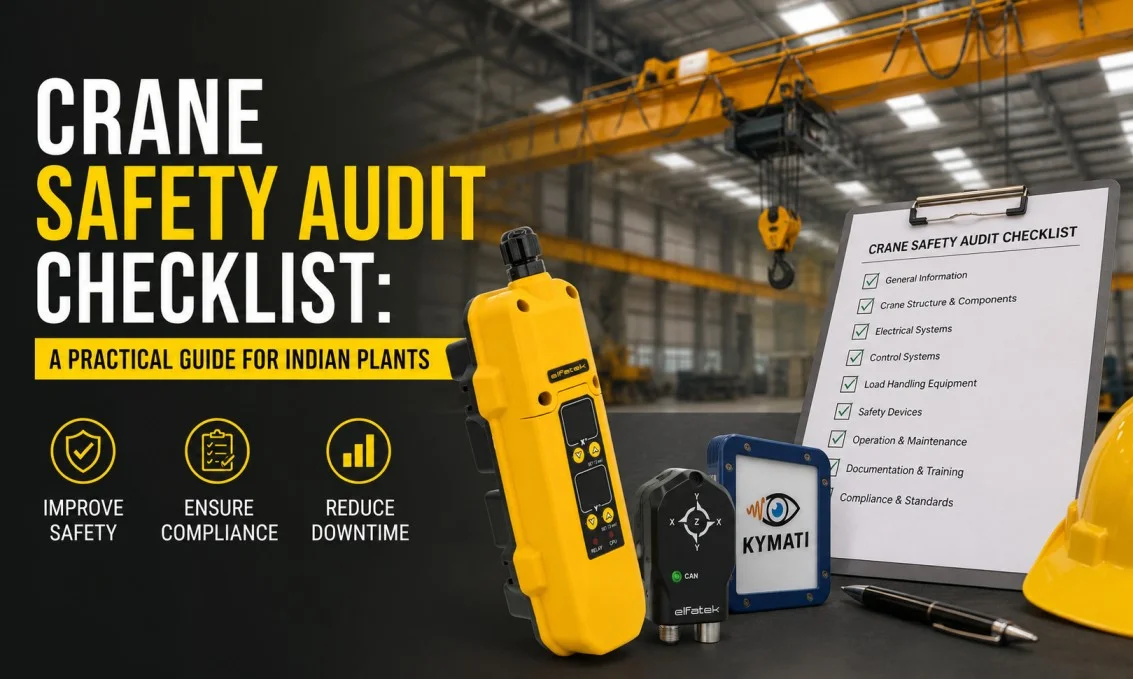
In an Indian plant, a crane is only as safe as the last audit that verified it. A single overloaded lift, a worn wire rope, or a limit switch that has quietly stopped working can turn a routine shift into a fatality investigation. That is why a structured crane safety audit checklist is no longer optional paperwork — it is the backbone of a compliant, insurable and genuinely safe lifting operation.
This guide gives plant managers, EHS heads and maintenance engineers a practical, standards-aligned checklist they can put to work immediately. It reflects the framework Indian industry now operates under, including the recent shift to the Occupational Safety, Health and Working Conditions (OSH) Code, 2020.
Why Crane Safety Audits Matter More Than Ever in India
Overhead cranes, EOT cranes, gantry cranes and hoists do the heavy lifting in steel plants, fabrication units, warehouses, cement facilities and engineering workshops across the country. When they fail, the consequences are severe — dropped loads, crushed operators, structural collapse and extended production shutdowns.
A crane safety audit is a systematic, documented inspection of the equipment, its safety systems, the operating environment and the records that prove ongoing compliance. Unlike a quick pre-shift check, an audit digs into the condition of load-bearing components, the calibration of safety devices and the integrity of controls — the things that quietly degrade until they cause an incident.
For Indian plants, three drivers make regular audits essential: legal compliance under the OSH Code and Bureau of Indian Standards (BIS) codes, insurance and liability protection, and the simple operational reality that unplanned crane downtime is expensive. A disciplined crane safety audit checklist addresses all three at once.
The Regulatory Framework Every Indian Plant Must Follow
Getting the compliance picture right is where many plants go wrong, because the legal landscape has changed.
The OSH Code 2020 — the new baseline
The Occupational Safety, Health and Working Conditions Code, 2020 came into force on 21 November 2025, consolidating 13 central labour laws — including the long-standing Factories Act, 1948 — into a single framework. The Central Rules under the Code were notified in May 2026, with state rules being finalised through the year. During this transition, the safety obligations that plants have followed for decades continue to apply.
The core duty is unchanged in spirit: lifting machines, chains, ropes and lifting tackle must be of sound construction, properly maintained, and thoroughly examined by a competent person at prescribed intervals, with proper registers maintained. Whether your reference point is the erstwhile Factories Act or the new OSH regime, the audit expectation is the same — regular, documented, competent examination of every crane and its lifting gear.
The BIS standards that define “safe”
Indian Standards give the technical yardstick your audit measures against:
- IS 3177:2020 — Electric Overhead Travelling Crane and Gantry Crane for all Applications, Code of Practice (Third Revision). This is the current, active version and the primary reference for EOT and gantry crane practice.
- IS 807:2006 — Design, erection and testing (structural portion) of cranes and hoists. It classifies cranes into eight duty groups (M1 to M8) based on operating hours and load spectrum, which directly informs how often and how rigorously a crane should be examined.
- IS 13367 — Safe use of cranes, Code of Practice. The practical “how to operate and inspect safely” companion standard.
- IS 4137 — Heavy-duty electric overhead travelling cranes for steelwork applications.
A good audit checklist is essentially these standards translated into questions your team can answer on the shop floor.
The Complete Crane Safety Audit Checklist
Use the sections below as a working template. Adapt the frequency and depth to your crane’s duty class and operating environment.
1. Pre-Audit Preparation and Documentation Review
Before touching the crane, verify the paperwork:
- Crane data plate present, legible, and matching the machine’s rated capacity (Safe Working Load).
- Manufacturer’s manual and load charts available on site.
- Records of the last thorough examination by a competent person, within the prescribed interval.
- Test and calibration certificates for load-testing and safety devices.
- Maintenance logs, breakdown history and previous audit non-conformance closures.
- Operator training and authorisation records.
Missing or expired documentation is one of the most common — and most avoidable — audit failures in Indian plants.
2. Structural and Mechanical Integrity
- Bridge girders, end carriages and crane structure free of cracks, corrosion, permanent deflection or weld failures.
- Bolted and welded connections tight and intact; no missing fasteners.
- Wheels and rails checked for wear, flange condition, alignment and end-stop/buffer integrity.
- Gearboxes and couplings free of abnormal noise, vibration, oil leakage or overheating.
- Bridge and trolley movement smooth across the full travel length.
3. Hoisting Mechanism — Ropes, Hooks, Drums and Brakes
This is the load path, so scrutiny must be high:
- Wire ropes inspected for broken wires, corrosion, kinks, birdcaging, reduction in diameter and proper spooling. Ropes meeting discard criteria must be replaced, never “run a little longer.”
- Hooks checked for cracks, wear at the saddle, throat opening (any increase indicates overload), and a functioning safety latch.
- Drums and sheaves free of groove wear, cracks and misalignment.
- Brakes — hoist and travel brakes holding rated load without drift; brake pads within wear limits and correctly adjusted.
4. Lifting Tackle and Below-the-Hook Devices
- Slings, chains, shackles, eyebolts and spreader beams marked with Safe Working Load and free from damage.
- Colour-coding / inspection-tag system in place and current.
- Any tackle showing distortion, wear, cuts or heat damage removed from service.
5. Safety Devices and Instrumentation
This is the heart of a modern crane safety audit — and the area most often found deficient. Every one of these devices should be present, functional and calibrated:
- Overload protection — a Safe Load Indicator (SLI) or Load Moment Indicator (LMI) that accurately warns and cuts out before rated capacity is exceeded. Calibration certificate current.
- Limit switches — upper and lower hoist limits, plus cross-travel and long-travel limits, all triggering reliably.
- Anti-collision systems — functional where multiple cranes share a runway, preventing crane-to-crane impact.
- Load cells and load-monitoring — reading accurately against a known test load.
- Emergency stop — accessible, clearly marked and cutting all motions instantly.
- Audible and visual alarms / zone protection — warning devices and area-limiting systems operating as intended.
When any of these devices is bypassed, disconnected or out of calibration, the crane is effectively operating blind. Verifying and maintaining them is where specialist safety-device suppliers add the most value.
6. Electrical Systems and Controls
- Control panels clean, properly enclosed (correct IP rating for the environment) and free of loose or overheated connections.
- Festoon systems or downshop conductors (DSL) intact and correctly insulated.
- Earthing and bonding continuous and tested.
- Pendant controls, and radio remote control transmitters, functioning correctly — no sticking buttons, clear labelling, reliable stop function and proper battery/signal behaviour.
- Motor and drive condition checked for overheating and abnormal operation.
7. Operator Competence, Signage and Environment
- Only trained, authorised operators using the crane.
- Standard hand signals and communication protocols understood and followed.
- Rated capacity clearly displayed on the crane.
- Aisles, load paths and stacking areas free of obstruction; adequate lighting and no overhead-line or clearance hazards.
8. Post-Audit Actions and Records
- Every non-conformance logged with a corrective action, owner and target date.
- Critical defects triggering immediate withdrawal of the crane from service.
- Audit report signed off and filed; re-verification scheduled for closed items.
How Often Should You Audit? A Practical Frequency Guide
A layered inspection regime is far more effective than a single annual scramble before the auditor arrives:
- Daily / pre-shift: Quick operator checks — brakes, limit switches, hook latch, controls, unusual noise.
- Monthly: Maintenance-team inspection of ropes, hooks, brakes and safety-device function.
- Quarterly: Deeper mechanical and electrical inspection, especially for high-duty cranes.
- Annual (thorough examination): Full statutory examination by a competent person, including load testing and calibration of safety devices, with formal certification — at least once every 12 months, and more frequently for heavy-duty (M6–M8) cranes.
Match the intensity to the crane’s IS 807 duty class: a crane running three shifts in a steel plant needs far tighter intervals than an occasional-use maintenance hoist.
Common Reasons Indian Plants Fail Crane Safety Audits
Across audits, the same gaps recur: expired or missing thorough-examination certificates; safety devices — especially SLIs and limit switches — that are bypassed or out of calibration; wire ropes kept in service past their discard point; incomplete maintenance and load-test records; and untrained or unauthorised operators. Almost every one of these is preventable with a disciplined checklist and correctly maintained safety instrumentation.
The Role of Certified Safety Devices in Passing Every Audit
A crane can be structurally sound and still fail an audit if its safety devices are missing, faulty or uncalibrated. This is precisely where the right instrumentation makes compliance repeatable rather than a last-minute effort.
At Aggra Cranes & Engineering LLP, we supply, install and calibrate the crane safety devices and control systems that sit at the centre of every audit checklist — Safe Load Indicators and Load Moment Indicators, hoist and travel limit switches, anti-collision systems, load cells, and reliable radio remote controls. Working with established technology partners including Kymati, Elfatek, GIS and Danfoss, we help Indian plants keep their overload protection, motion limiting and control systems audit-ready around the year.
Getting your safety instrumentation specified, installed and calibrated correctly turns the audit from a stressful event into a formality — and, far more importantly, keeps your operators and loads safe every single lift.
Conclusion
A crane safety audit checklist is more than a compliance document — it is a structured way to protect people, equipment and production. With the OSH Code 2020 now the governing framework and IS 3177:2020 and IS 807 setting the technical bar, Indian plants have a clear standard to meet. Build the checklist into a layered daily-to-annual regime, keep your safety devices calibrated and your records complete, and every audit becomes confirmation of a system that is already working.
If you want to make sure your cranes’ safety devices and control systems are audit-ready, the team at Aggra Cranes can help you assess, upgrade and maintain them.
Frequently Asked Questions
-
What is a crane safety audit checklist and is it mandatory in India?
A crane safety audit checklist is a structured tool used to systematically inspect a crane’s structure, hoisting mechanism, lifting tackle, safety devices, controls and records against applicable standards. In India, cranes are lifting machines that must be soundly maintained and thoroughly examined by a competent person under the Occupational Safety, Health and Working Conditions Code, 2020 (which came into force in November 2025, replacing the Factories Act, 1948), supported by BIS standards such as IS 3177:2020 and IS 807. So while the format of the checklist is yours to design, the underlying duty to inspect and certify cranes is a legal requirement.
-
How often should cranes be inspected or audited in an Indian plant?
Best practice is a layered regime: daily pre-shift checks by the operator, monthly inspections by the maintenance team, quarterly deeper checks, and a full thorough examination by a competent person at least once every 12 months. High-duty cranes (IS 807 classes M6–M8) running multiple shifts should be inspected more frequently. The annual examination typically includes load testing and calibration of safety devices, with formal certification.
-
Which Indian standards apply to a crane safety audit?
The key references are IS 3177:2020 (Electric Overhead Travelling and Gantry Cranes — Code of Practice, current third revision), IS 807:2006 (structural design, erection and testing of cranes and hoists, including the M1–M8 duty classification), IS 13367 (Safe use of cranes — Code of Practice) and IS 4137 (heavy-duty EOT cranes for steelwork). These sit alongside the statutory framework of the OSH Code 2020 and its rules.
-
Who is qualified to conduct a crane safety audit?
Routine daily and monthly checks can be done by trained operators and in-house maintenance staff. However, the statutory thorough examination and load testing must be carried out by a “competent person” — an individual or agency with the requisite qualification, experience and, where applicable, recognition under the relevant rules to examine lifting machinery and issue certification. Many plants combine an internal audit team with an external competent person for the annual examination.
-
What safety devices are checked during a crane safety audit?
The critical safety devices include overload protection via a Safe Load Indicator (SLI) or Load Moment Indicator (LMI), upper/lower hoist and travel limit switches, anti-collision systems where cranes share a runway, load cells, emergency stops, and audible/visual warning or zone-protection systems. Each must be present, functional and, where relevant, calibrated with a current certificate. Suppliers such as Aggra Cranes specialise in providing, installing and calibrating these devices to keep cranes audit-ready.